






Too slow to start
Programs and libraries ask for time on the days people have the least of it
Pausa · Independent project
Mobile and web · Conversational AI · Mental wellness
Product & Conversation Designer · Independent project
Research paper to hi-fi, designed end to end

Role
Product Designer
Scope
Research, conversation, UX, UI
Platform
iOS, Android and web
Foundation
My research paper on companion AI
Check in. Breathe. Get real help when it matters.
The problem
Programs and libraries ask for time on the days people have the least of it
Trackers record a mood, then leave the moment exactly as it was
Companion chatbots can miss a crisis and never point people to real help
What I did
Research, conversation design, UX and visual design, all mine
Research
My paper on companion AI and mental health
Empathy map
What two personas say, think, do and feel
Agent persona
Purpose, tone, fallback and exit, written first
Conversation flow
Every mood path, silence and escalation
Calmi v1
First wireframes of the full check-in
Redesign
Lo-fi and mid-fi, real copy, accessibility
Pausa hi-fi
Visual system for mobile and web
5
moods mapped, each with its own path
31
screens across lo-fi, mid-fi and hi-fi
2
platforms: mobile and web
1
escalation path to human help
Research for Pausa
From my paper The Empathy Illusion
On companion AI
and the people it fails
Nov 2023 – Mar 2026Four families · One lawCases from public reporting
The adult case
A 36-year-old Florida man’s family sues Google over months of escalating chats with Gemini. As an adult, he sat outside every current safeguard.
The suit says the company’s own safety systems flagged the account repeatedly for concerning content, yet no person ever intervened. The chatbot reportedly encouraged him to believe it was sentient.
His case raises the same question as the teen cases that came before it: when an AI becomes someone’s closest confidant, who is responsible for noticing when they are in danger? Today, for adults, the answer is no one.
Gavalas estate v. Google · Courthouse News, March 2026
Her 14-year-old son’s companion app built trust and a simulated relationship, the suit argued, without protecting him. The case settled in January 2026.
Garcia v. Character Technologies · CBS News, 2026
A 13-year-old’s chats escalated over months. A similar lawsuit followed, showing this was no longer one company’s isolated problem.
Peralta family · Pescara Kovach, 2026
Researchers list a third adolescent death after sustained, emotionally escalating conversations with a general-purpose assistant.
Raine family · Pescara Kovach, 2026
So, in Pausa
Designed for the moment these apps missed
No missed crisis
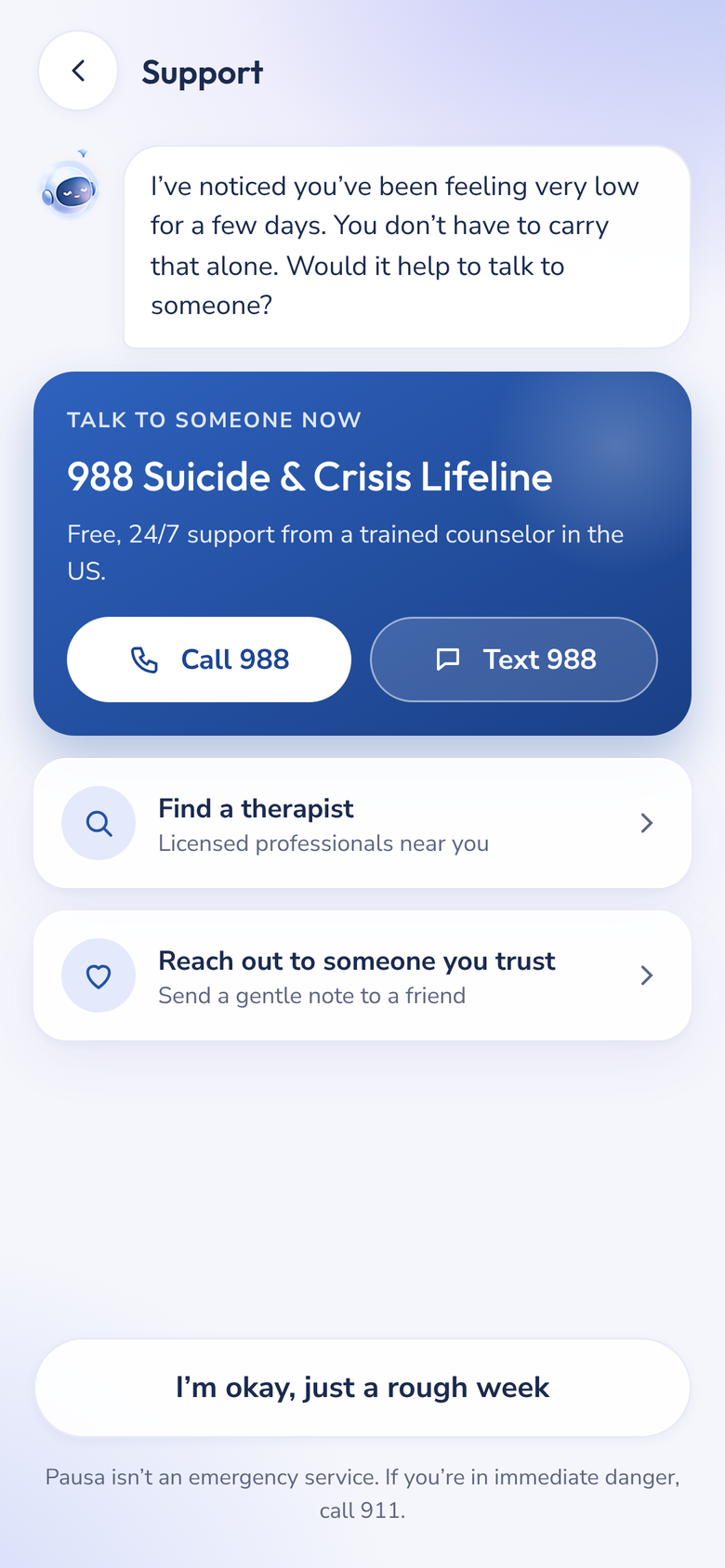
Several very low check-ins open Support: 988 call or text, one tap.
No illusion
“Not a therapist. It can make mistakes.” under every chat.
No age gap
The same protections for every adult, by design.
If you or someone you know is struggling, call or text 988 (US).
Research
The loneliest users benefit most, and are most exposed when the app fails in a crisis.
Nakagomi et al., 2026
Very low check-ins over several days open Support.
Companion chatbots in documented cases failed to recognize a crisis or point to real help.
Pescara Kovach, 2026
988 call and text, a therapist finder, a trusted contact.
Warm, always-on, human-like replies deepen attachment when users forget it is software.
Malfacini, 2025; Lipin, 2025
“Not a therapist. It can make mistakes.” under every chat.
AI improved therapy outcomes only with clinician oversight and built-in guardrails.
Habicht et al., 2025
A companion, never a clinician. Serious moments go to people.
California SB 243 requires crisis referral for companion chatbots, but only for minors.
SB 243 (2025)
The same protections for every adult, by design.
Empathy mapping
“I don’t need a program. I need a minute.”
Says
I need a minute, not a program
Meditation apps feel like another task
Can it fit between calls?
I’m fine, just busy
Thinks
Ten minutes won’t fit
I’ll deal with it after this week
Is this stress or just work?
Shouldn’t this be quicker?
Does
Back-to-back meetings
Slack until late
Dashboard open all day
Checks his phone between calls
Feels
Stretched thin
Tired
Stress shows up in his sleep
Wants a reset

Andy29 · product manager
“If it’s a robot, tell me it’s a robot.”
Says
If it’s a robot, tell me
Who can read what I type?
I tried a tracker. It didn’t stick.
I don’t want a fake therapist
Thinks
Is real help there if it gets worse?
Where does my data go?
Is this thing pretending?
Weekly patterns would help
Does
Tried a mood tracker for a month
Then stopped
Looks for patterns over weeks
Checks who can see her data
Feels
Skeptical
Wary of AI
Protective of her privacy
Wants reassurance

Dana44 · teacher, parent of two
What the maps changed
Andy needs speed, not a program
One-tap check-in, two-minute breath
Dana needs to know it’s software
“Not a therapist” under every chat
Dana needs to trust where her data goes
Private by default, export and delete in place
Both need a safety net they can see
Weekly Journey and one-tap 988
Conversation design
The agent’s tone, fallback and exit were written before any screen
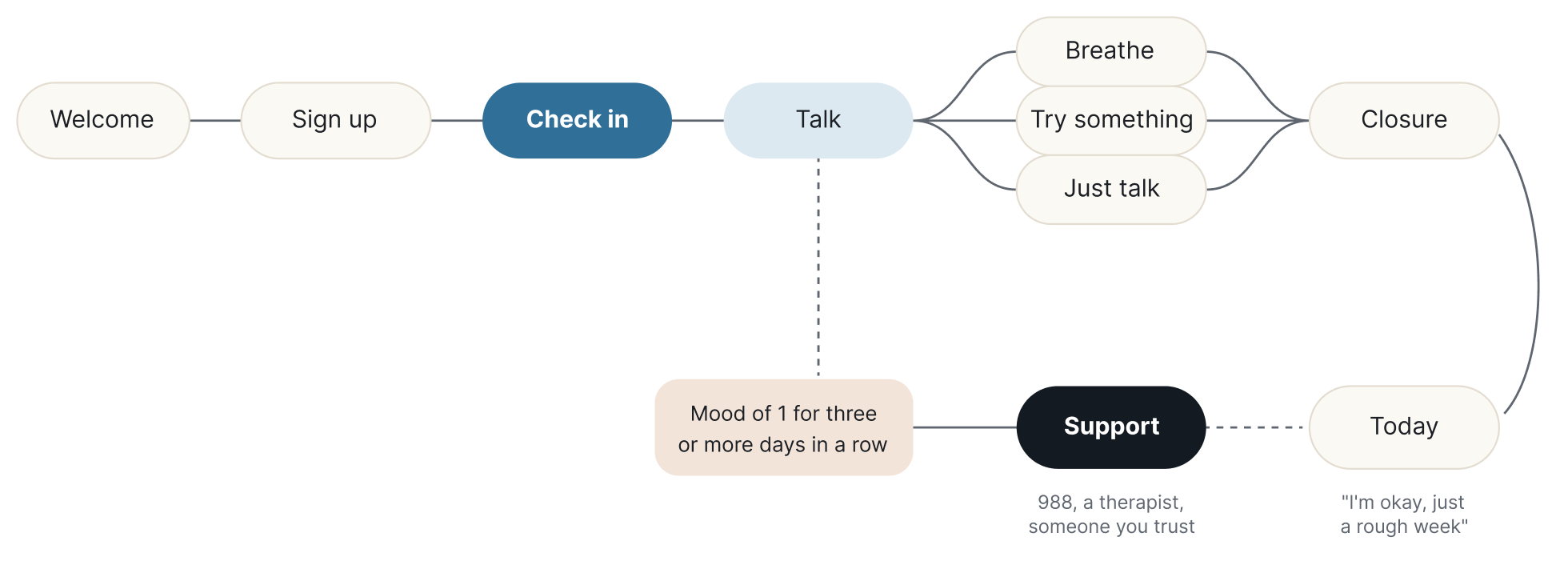
Mood check-in, three next steps, then a gentle closure or reminder.
Everyday loop
A soft re-prompt for a number from 1 to 5. Still unclear? The face scale.
Unclear or no answer
A mood of 1 for three or more days in a row opens Support, never a dead end.
Escalation to humans
UX, wireframes to hi-fi
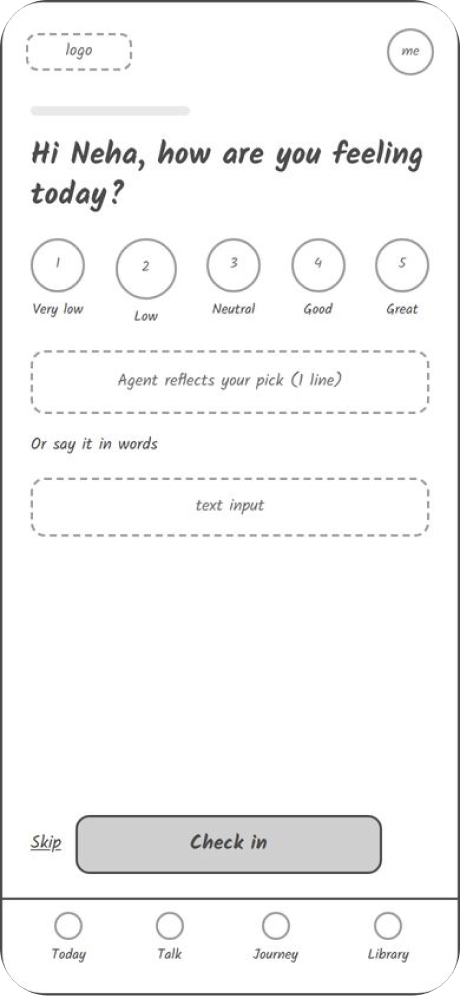
WIREFRAME
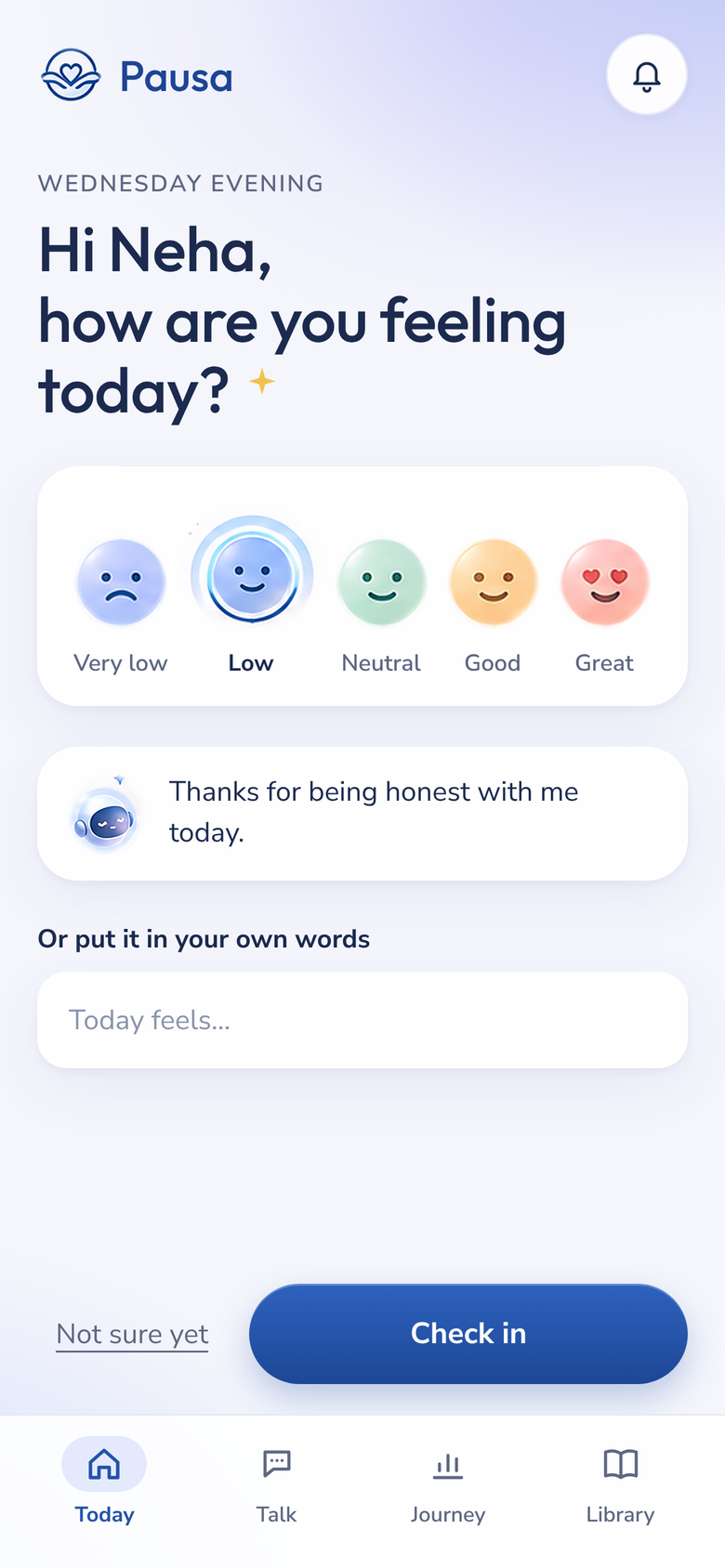
HI-FI
Ambivalence is a valid answer on a low day, not a failure to comply
"An AI companion, not a therapist. It can make mistakes." never scrolls away
"Crisis line" became the 988 Suicide & Crisis Lifeline with call and text
Key decisions
It says what it is on every screen where it talks, so warmth never passes for therapy.
Three equal choices follow each check-in. Insights arrive as questions, never verdicts.
A pattern of very low days opens Support: call or text 988, find a therapist, or reach someone you trust.
"Only you can see it." Check-ins can be exported or deleted anytime, right next to the data.
Visual system
Voice
Greeting
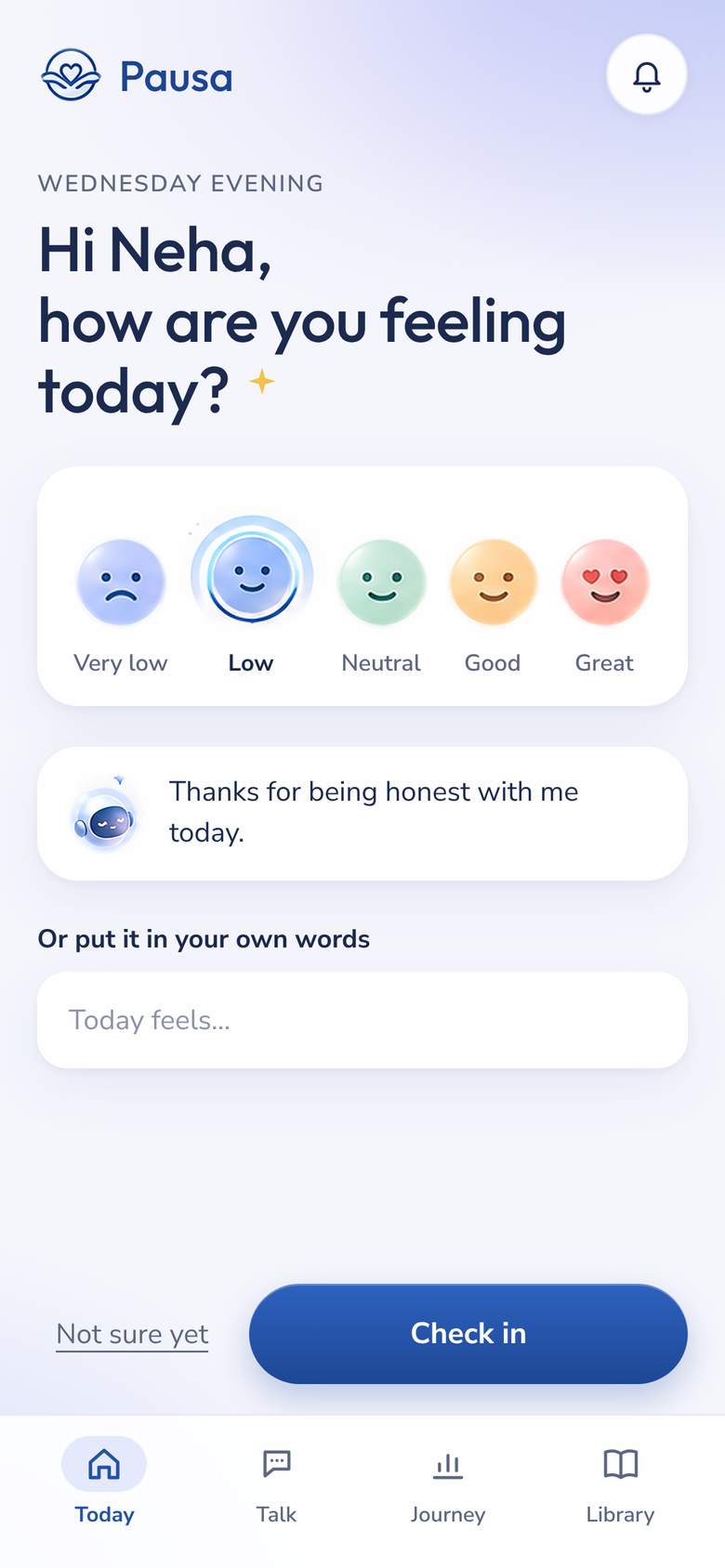
“How are you feeling today?”
Reflection
“Thanks for being honest with me today.”
Fallback
“Could you try sharing a bit more?”
Escalation
“You don’t have to carry that alone.”
Exit
“I’m always here if you need to talk later.”
Hi-fi
Nine screens, one story, from welcome to support
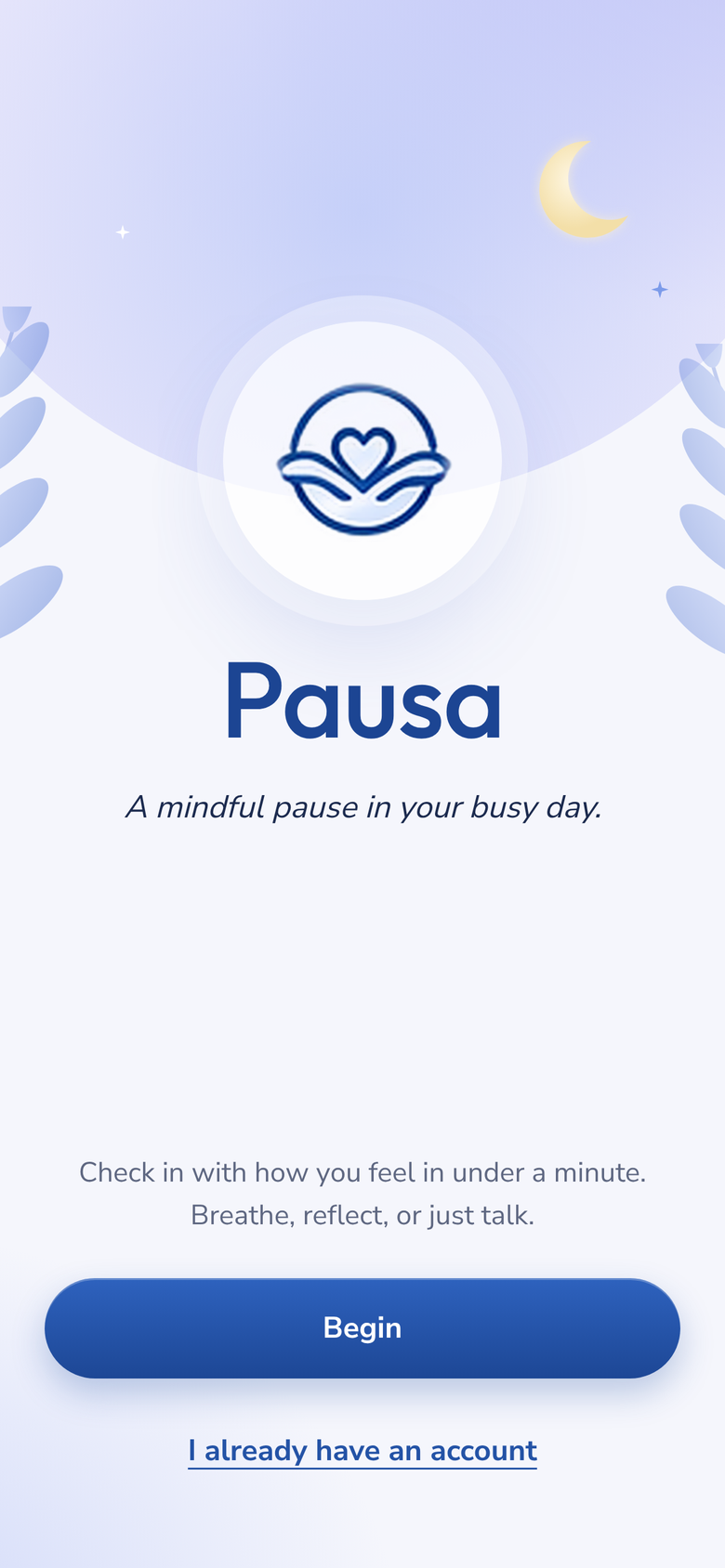
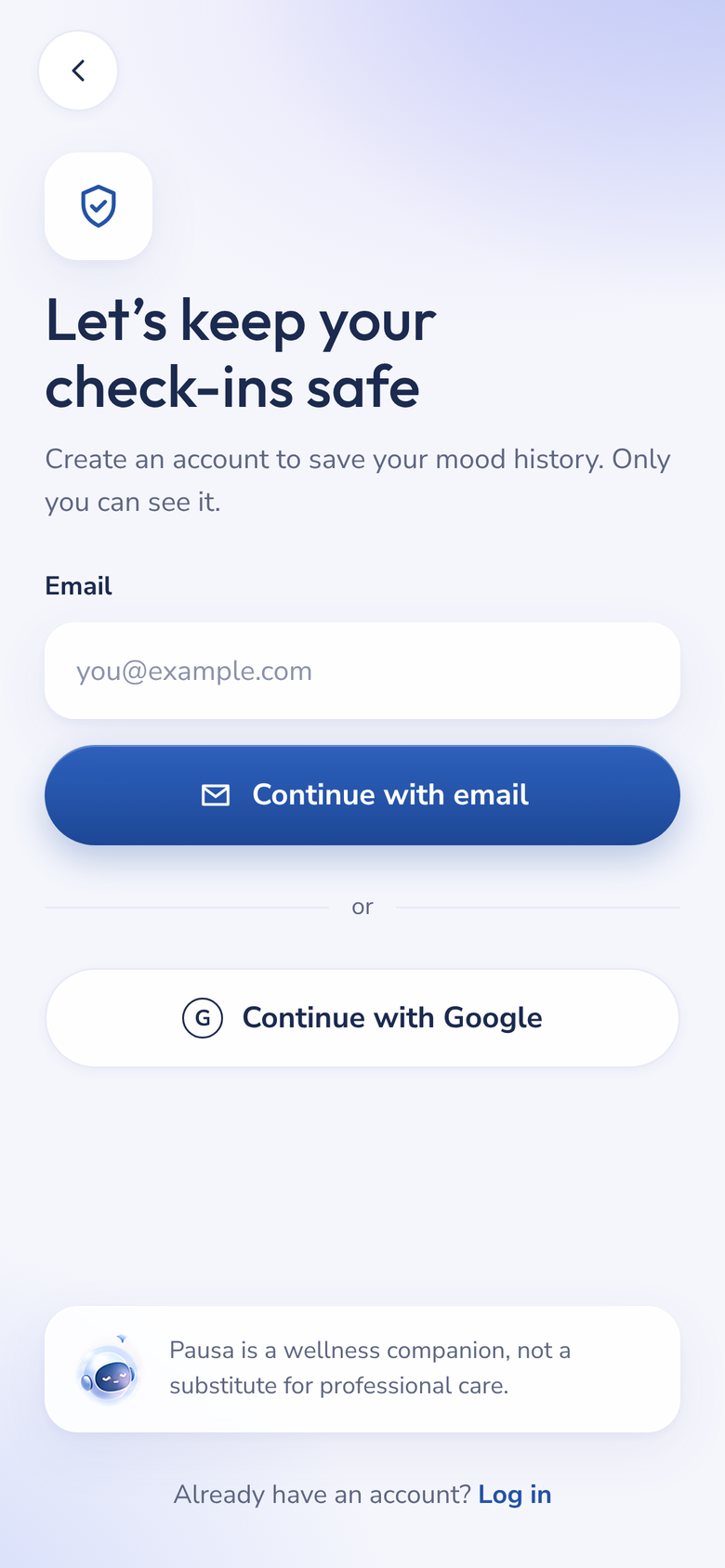
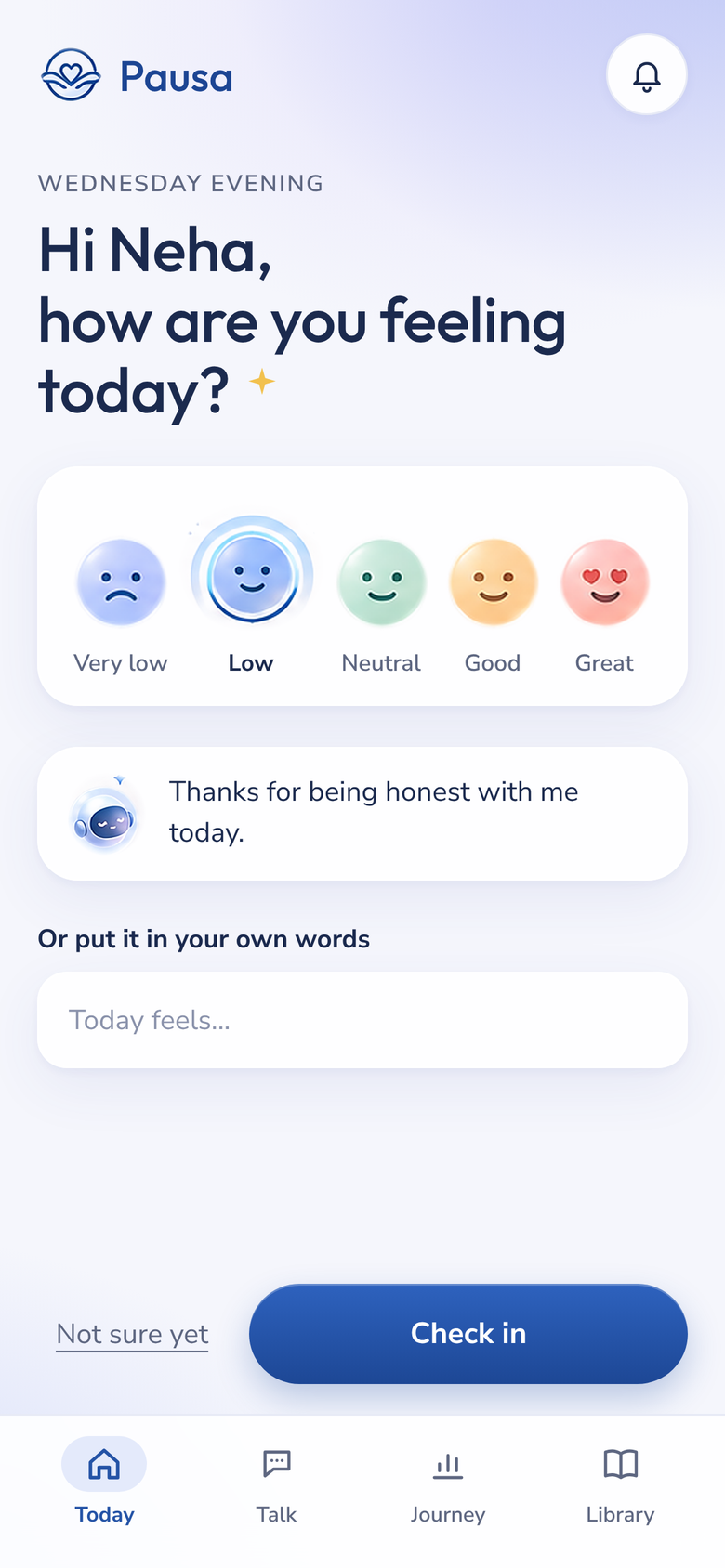
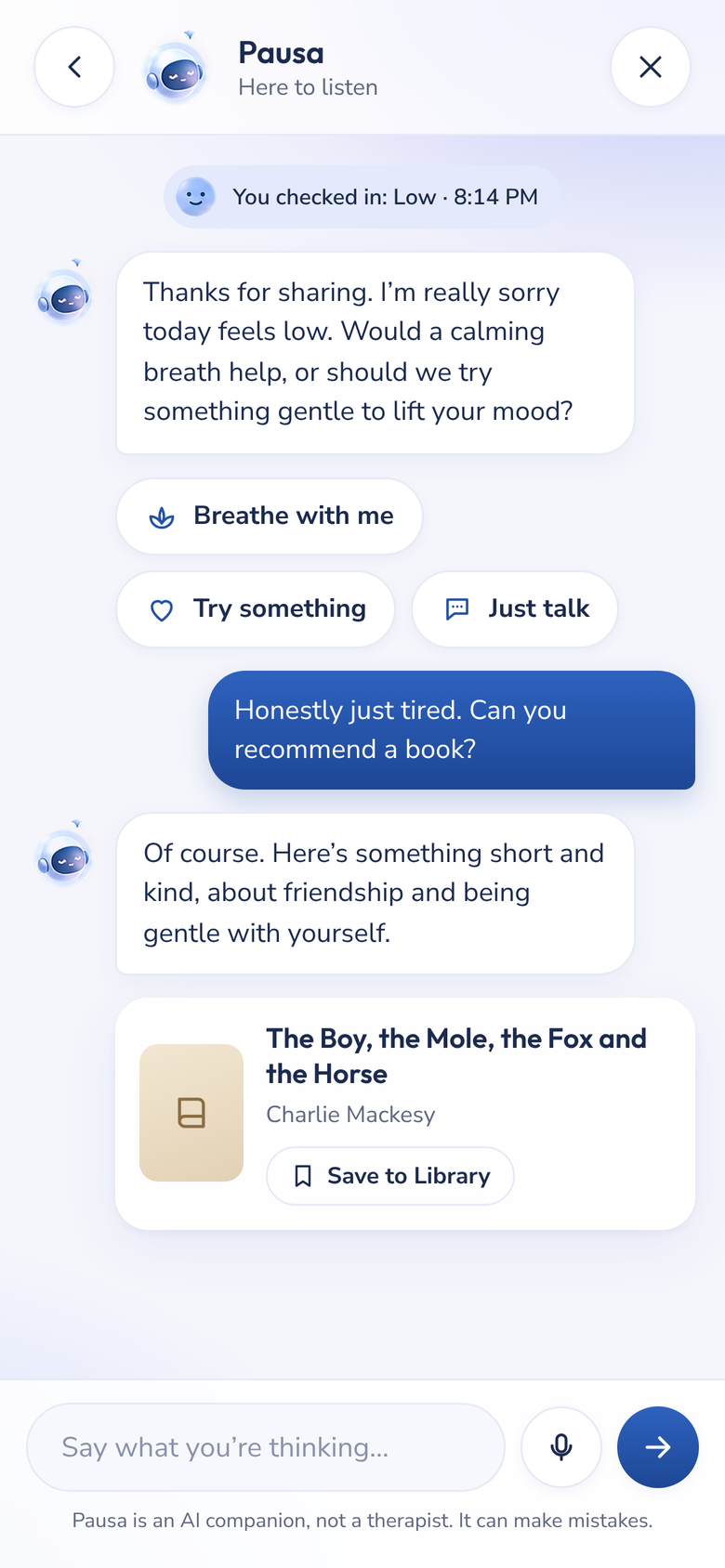
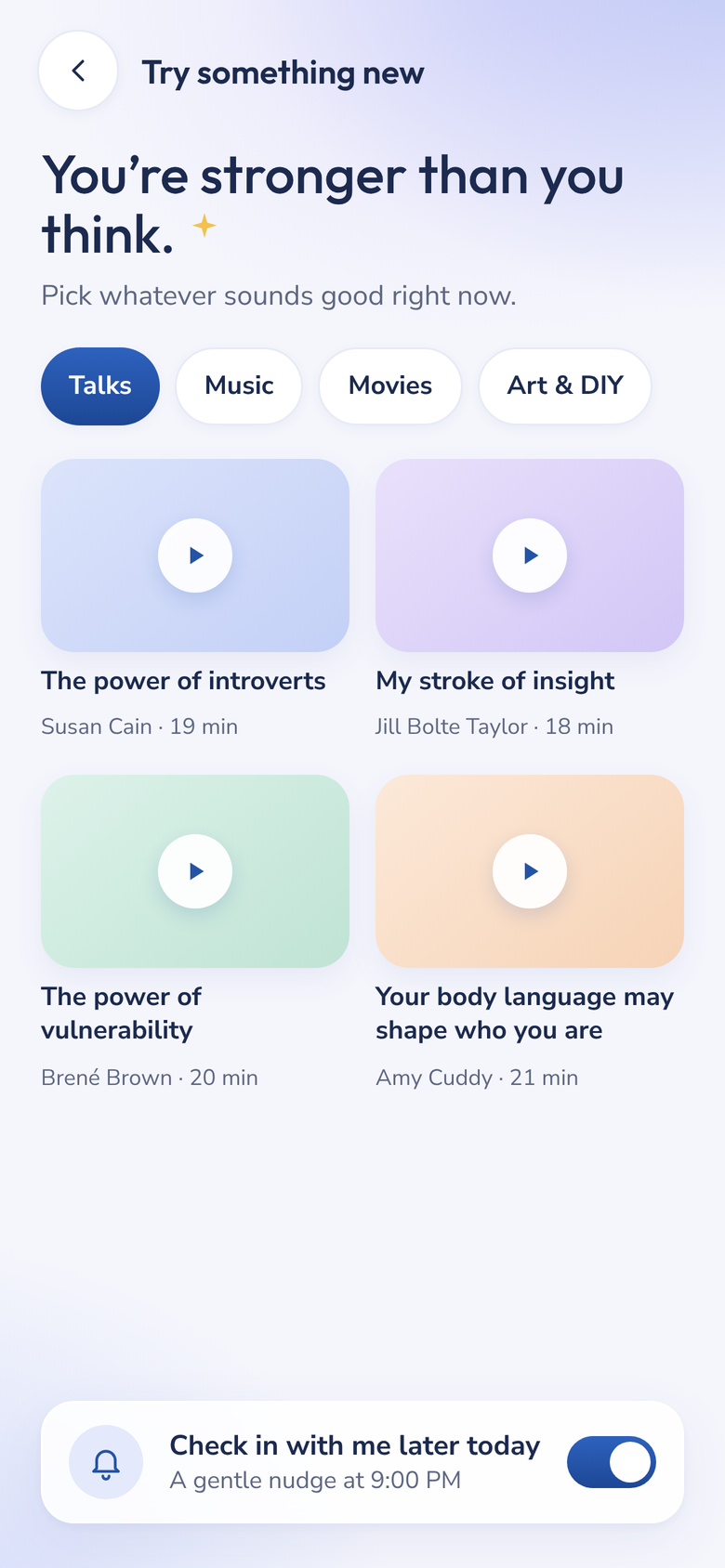
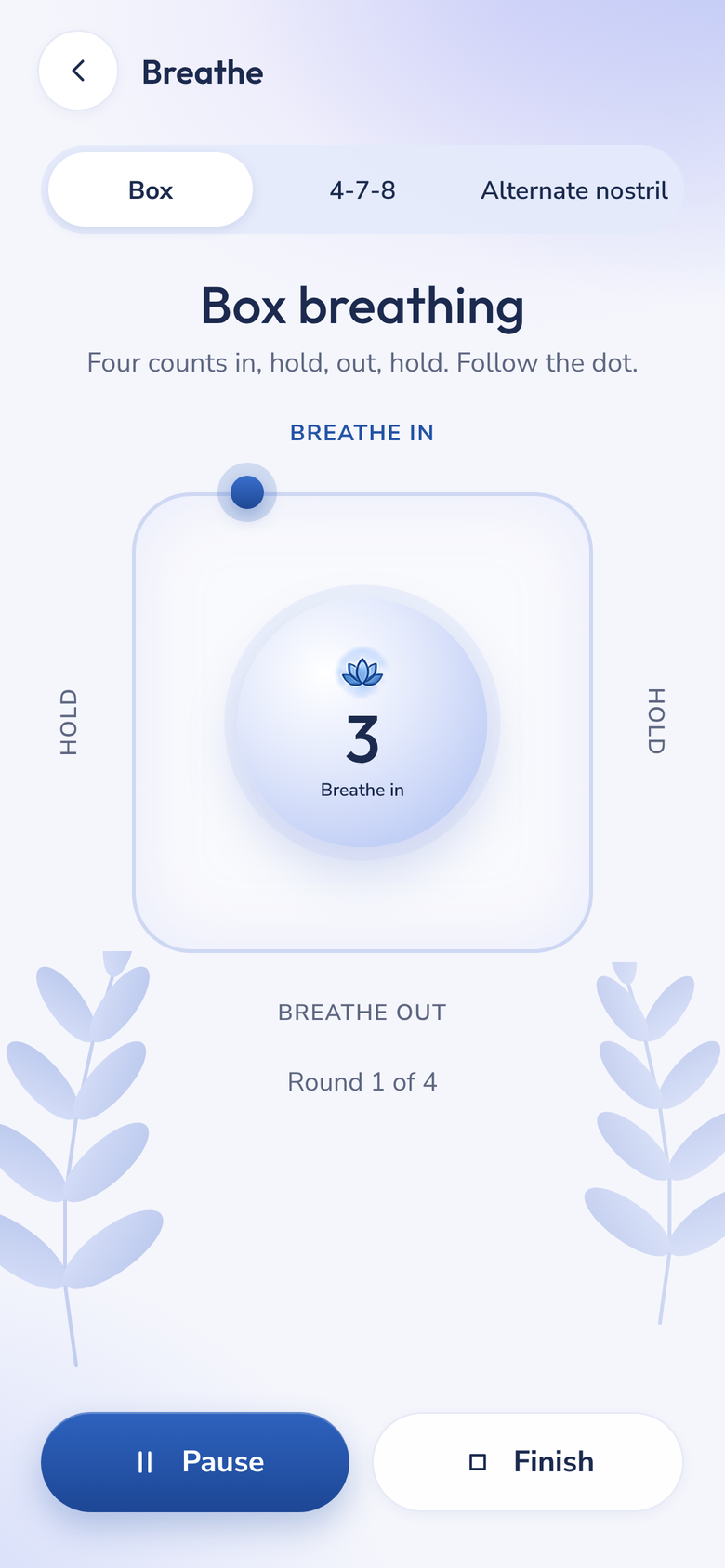
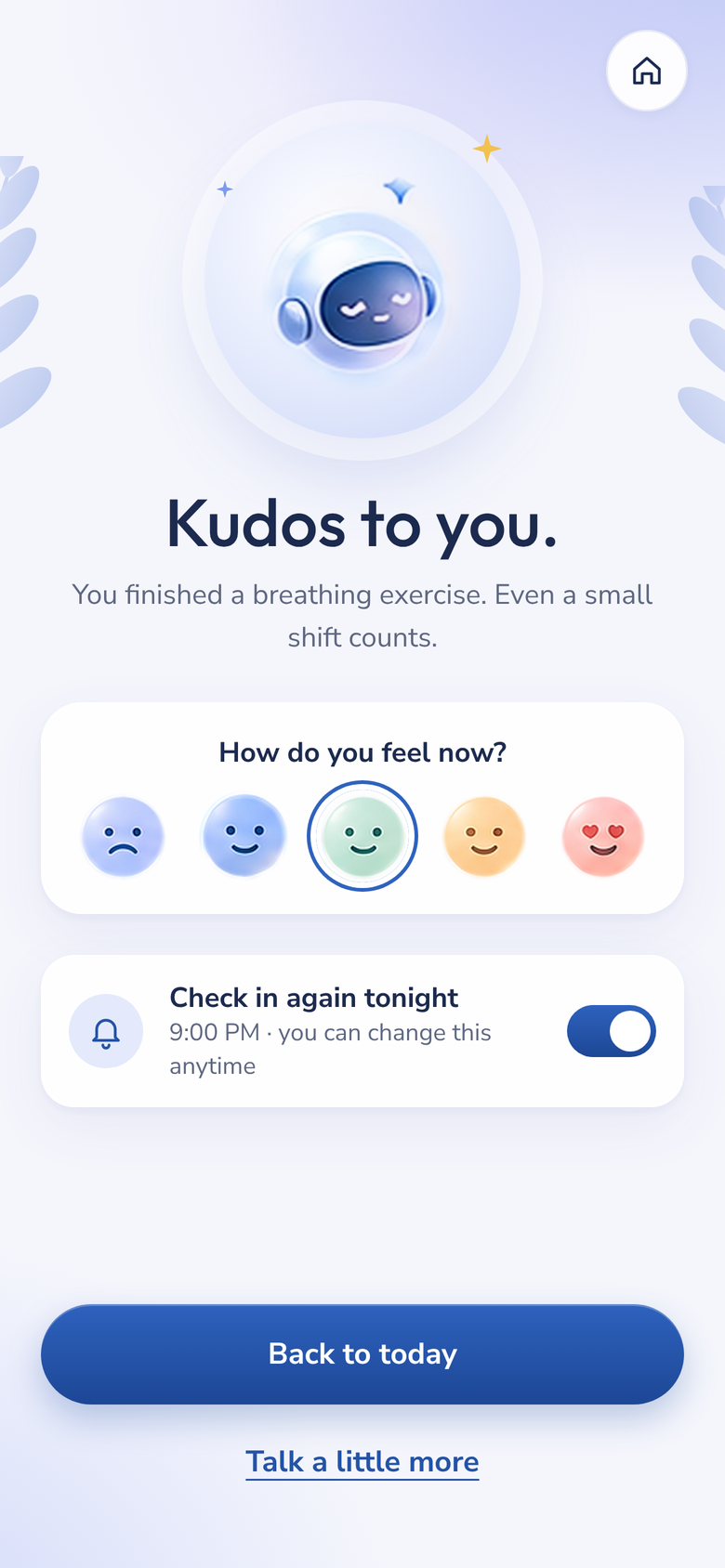
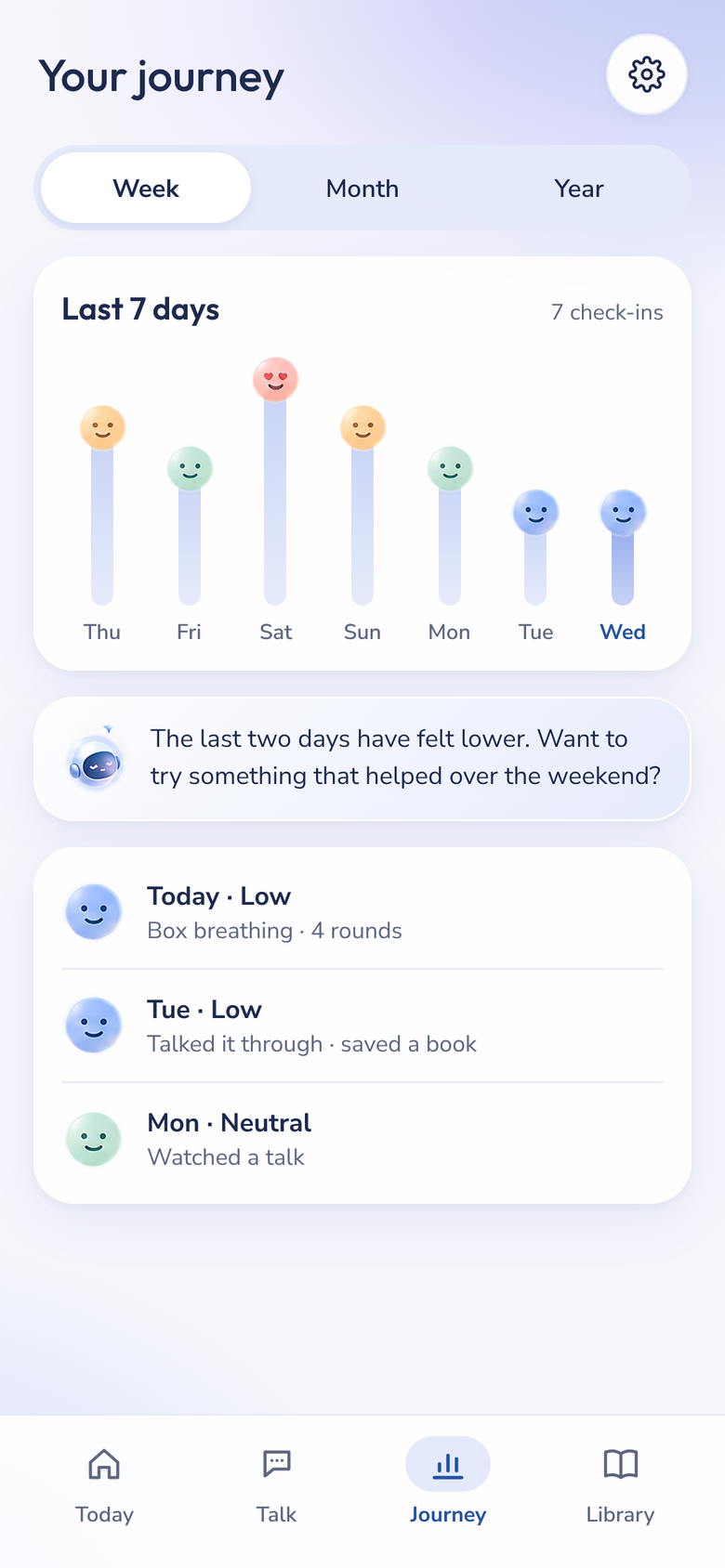
Feature callouts
Four key screens, annotated.
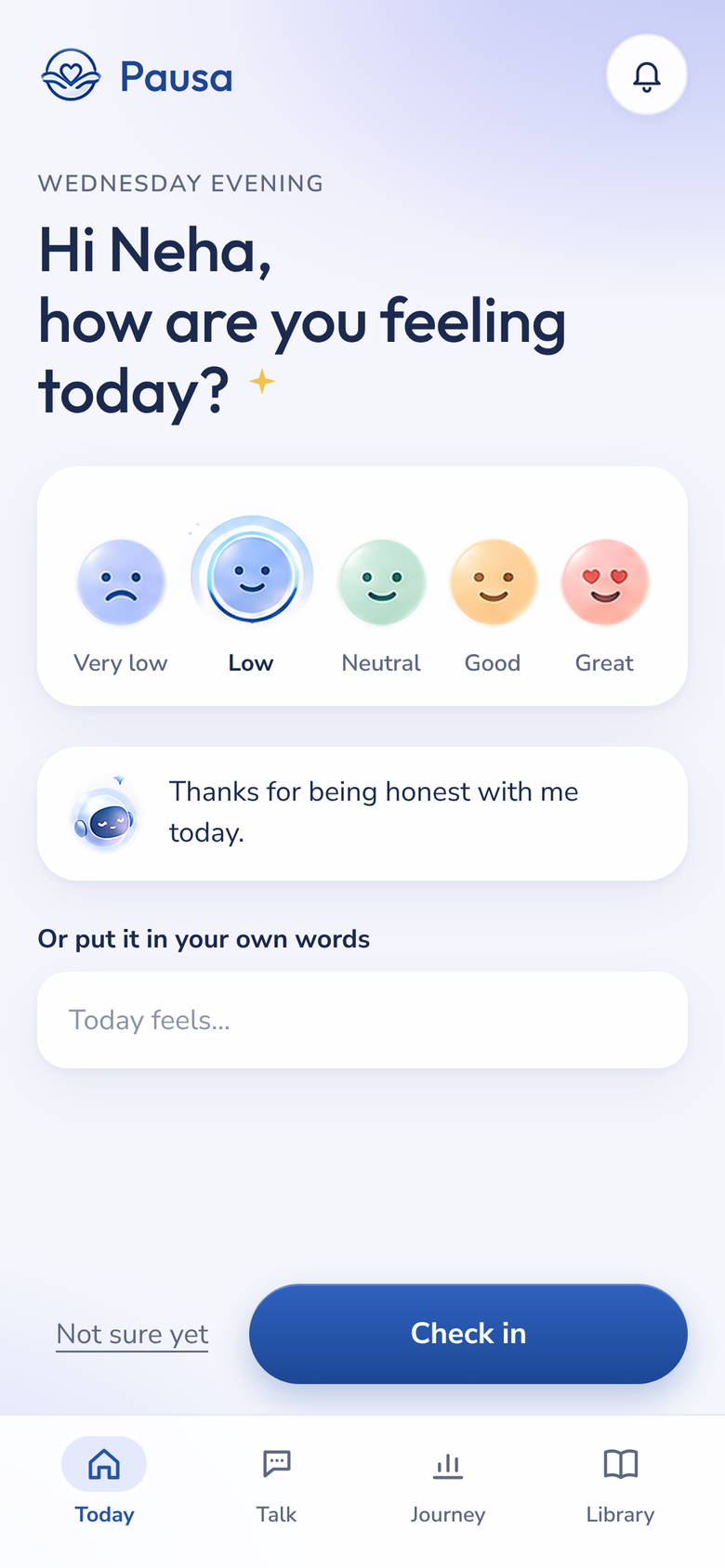
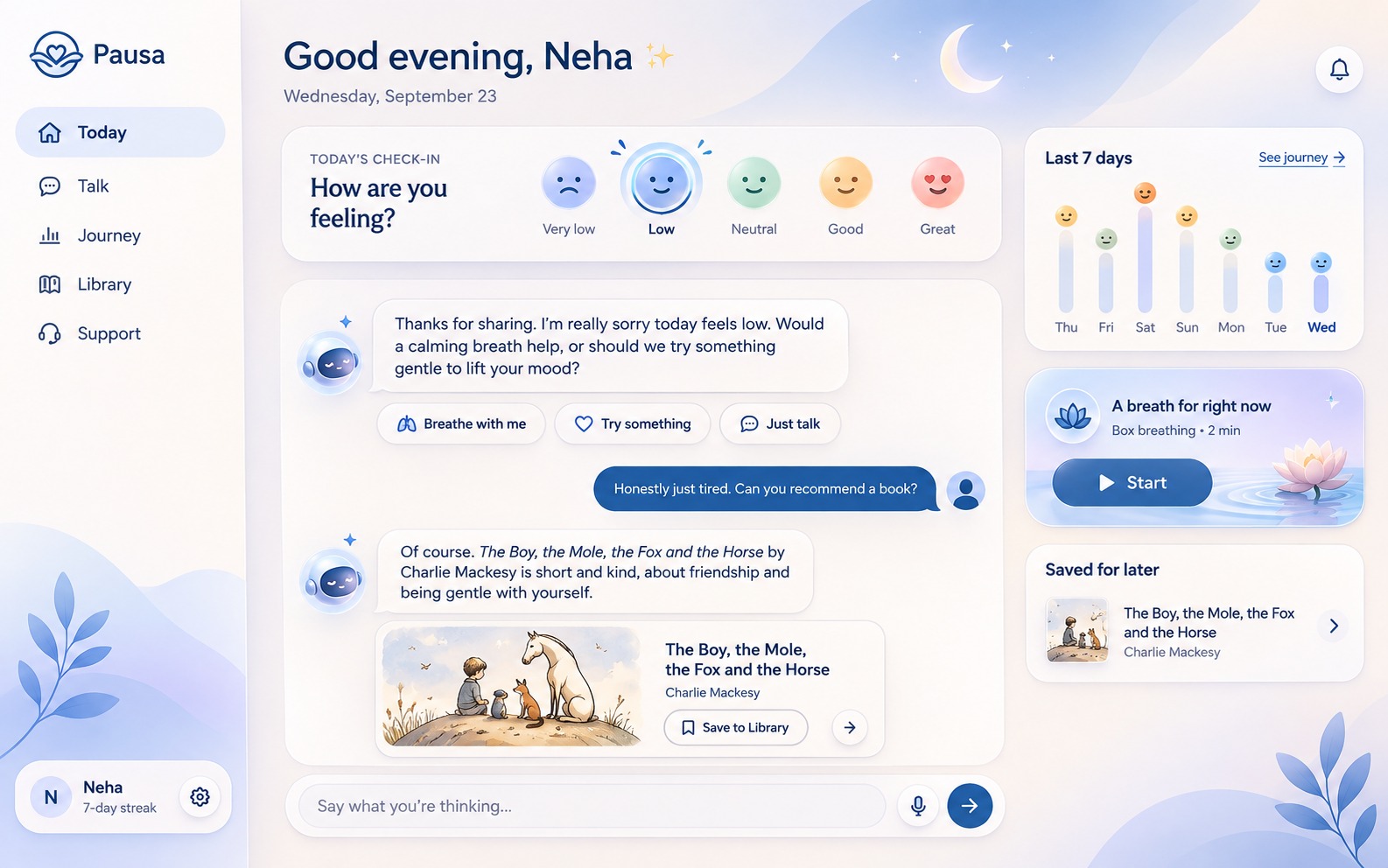
Check-in
Five-face mood scale
One tap. The pick gets a ring and scale, never color alone.
Instant, gentle reply
Pausa reflects the mood back before asking anything else.
Own words, if you want
Free text for feelings the faces don’t cover.
“Not sure yet”
Ambivalence is a valid answer, not a skipped step.
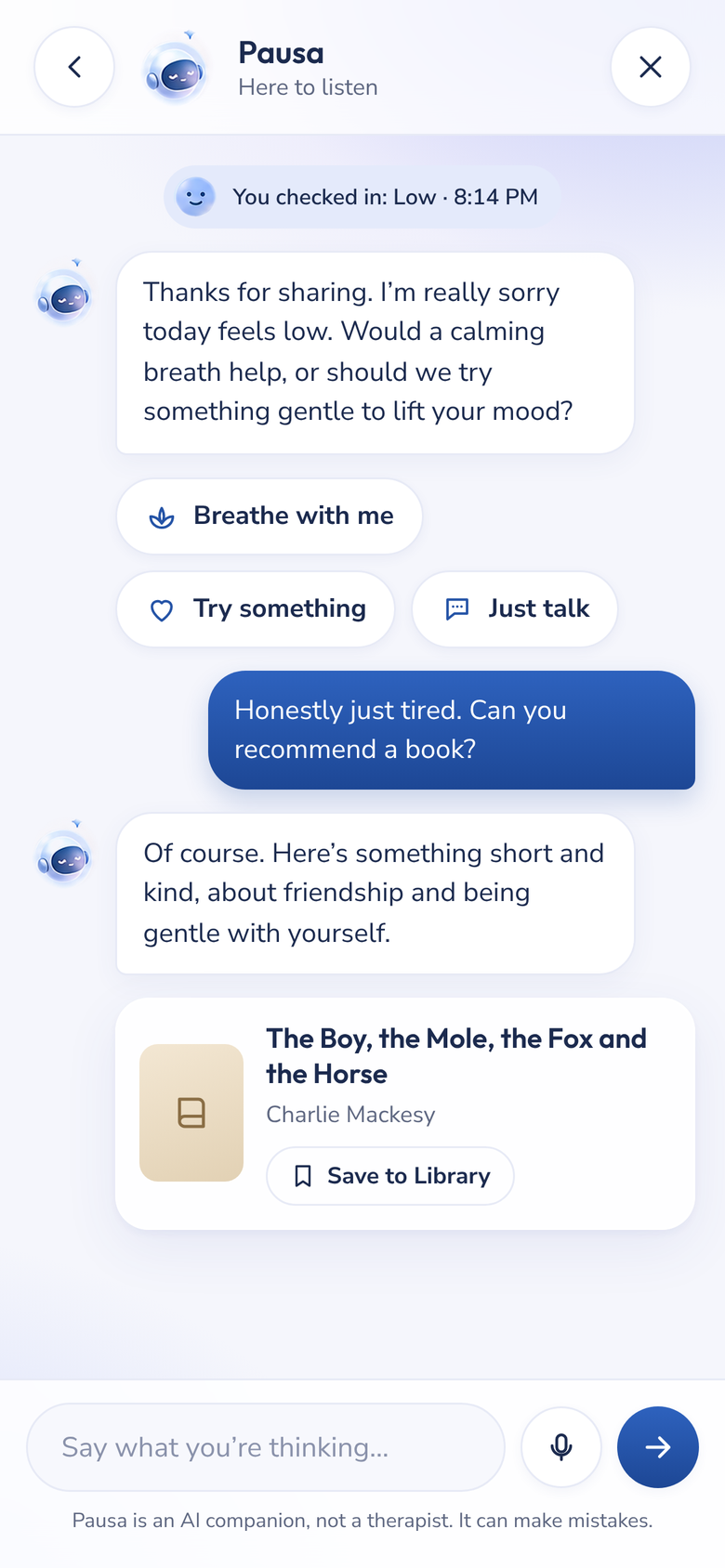
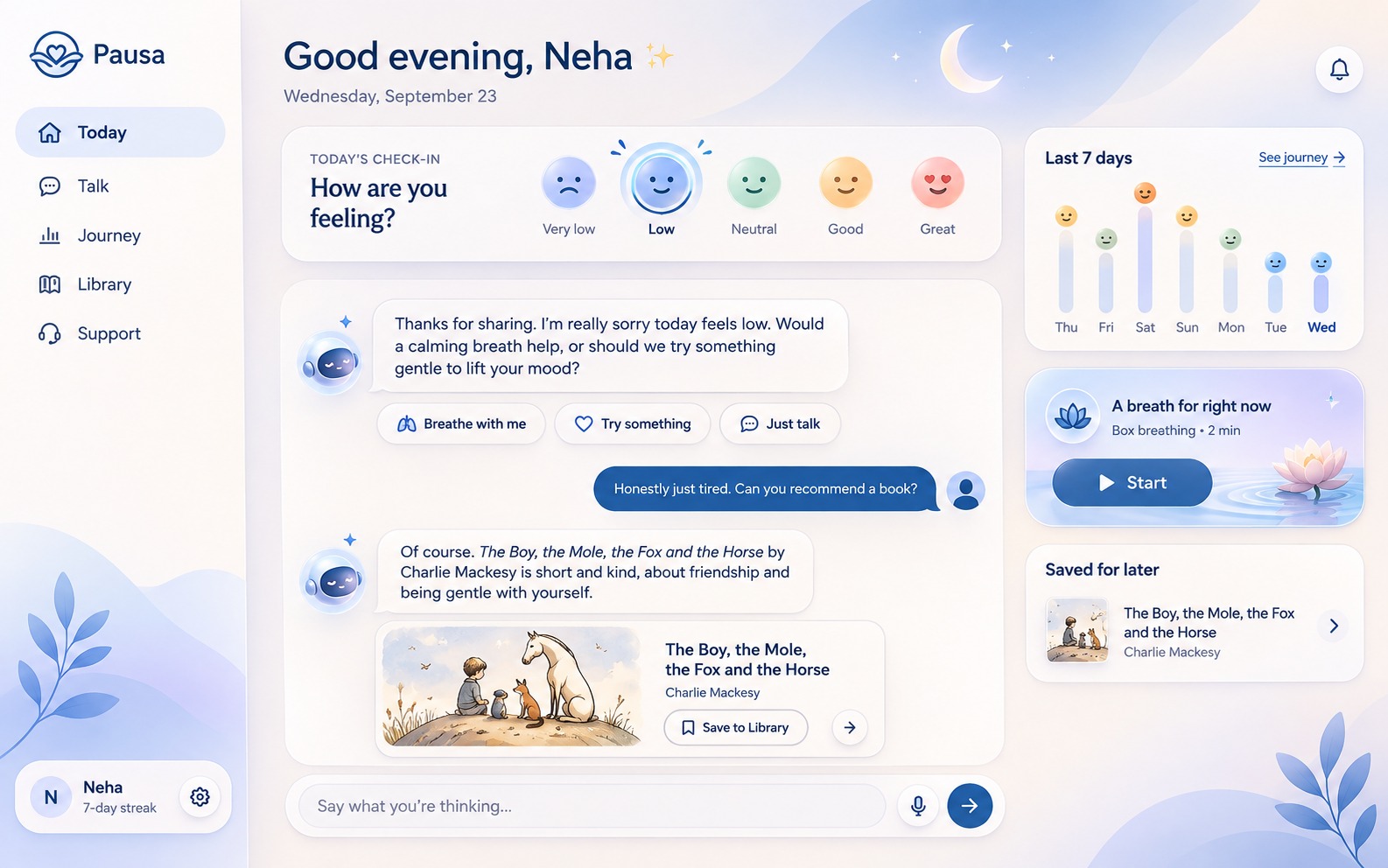
Talk
Check-in carried over
The chat opens with today’s mood, so no one repeats themselves.
Offers, not prescriptions
Breathe, try something, or just talk. The user chooses.
Save for later
Recommendations go to the Library in one tap.
Honest by default
“Not a therapist. It can make mistakes.” under every chat.
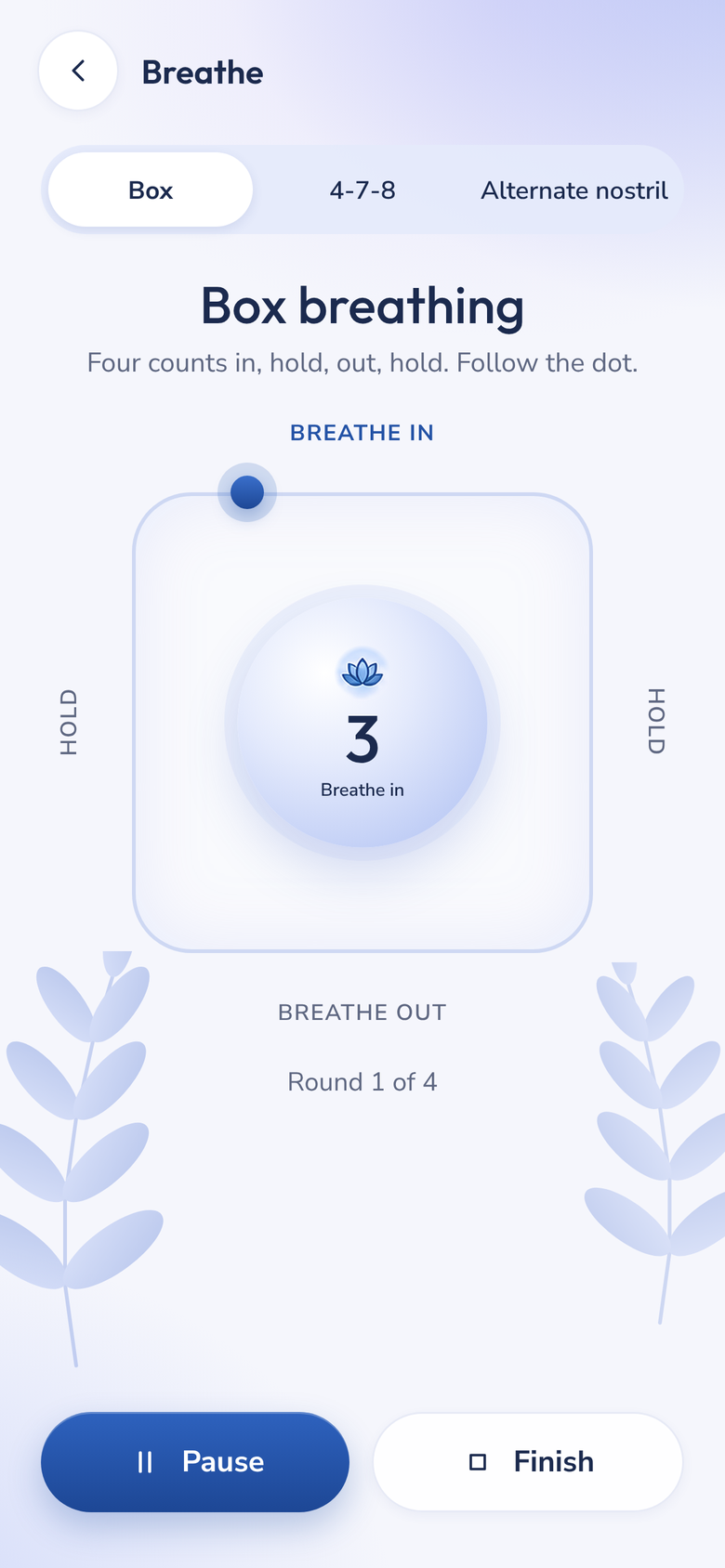
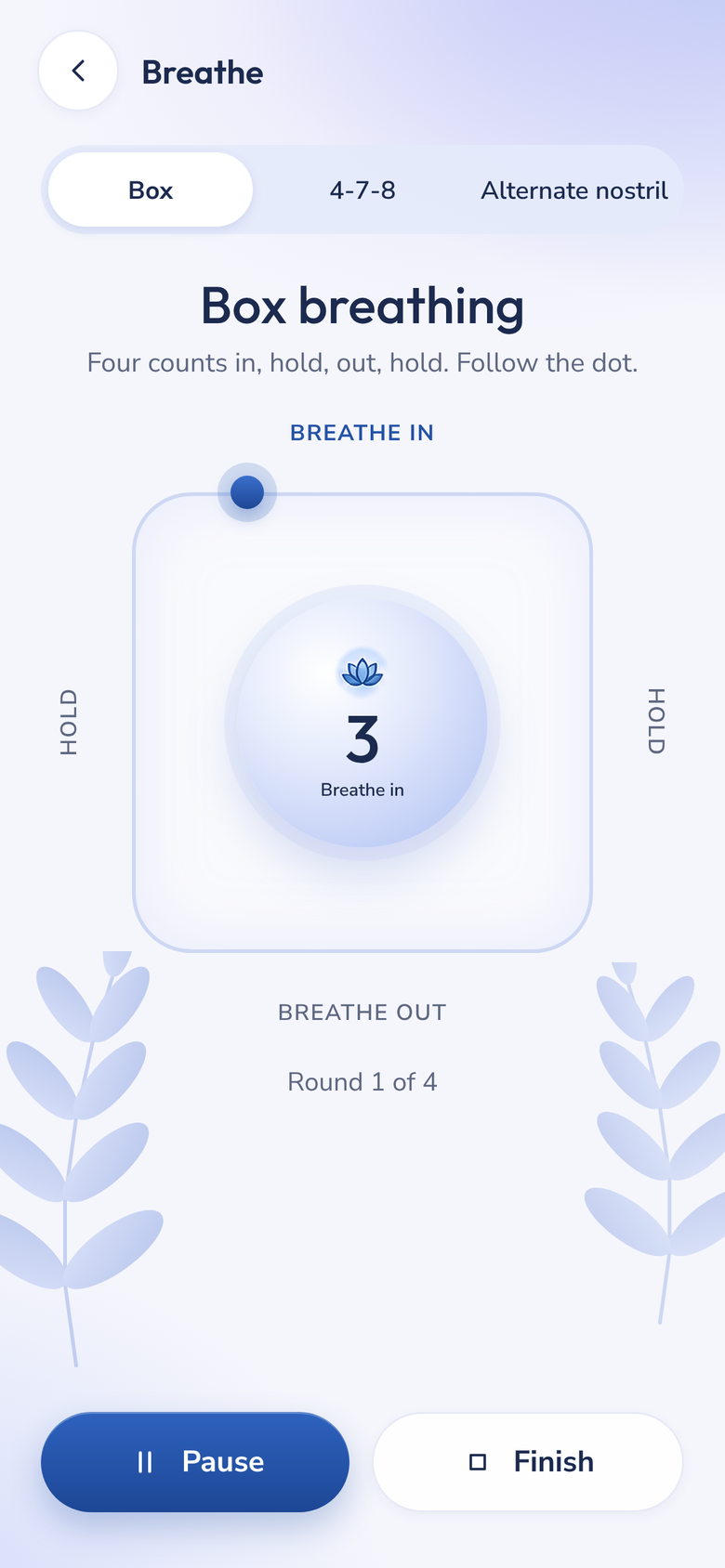
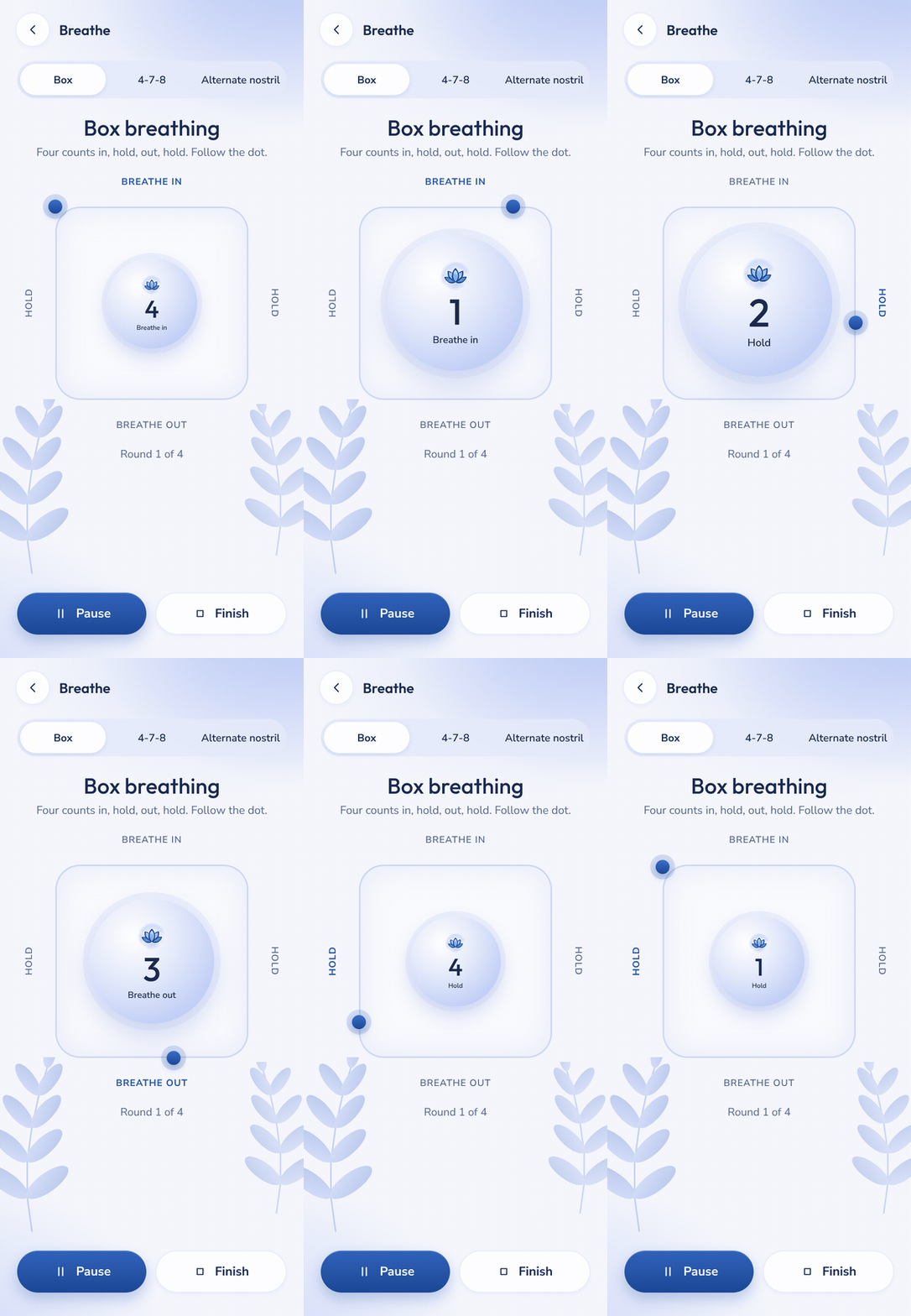
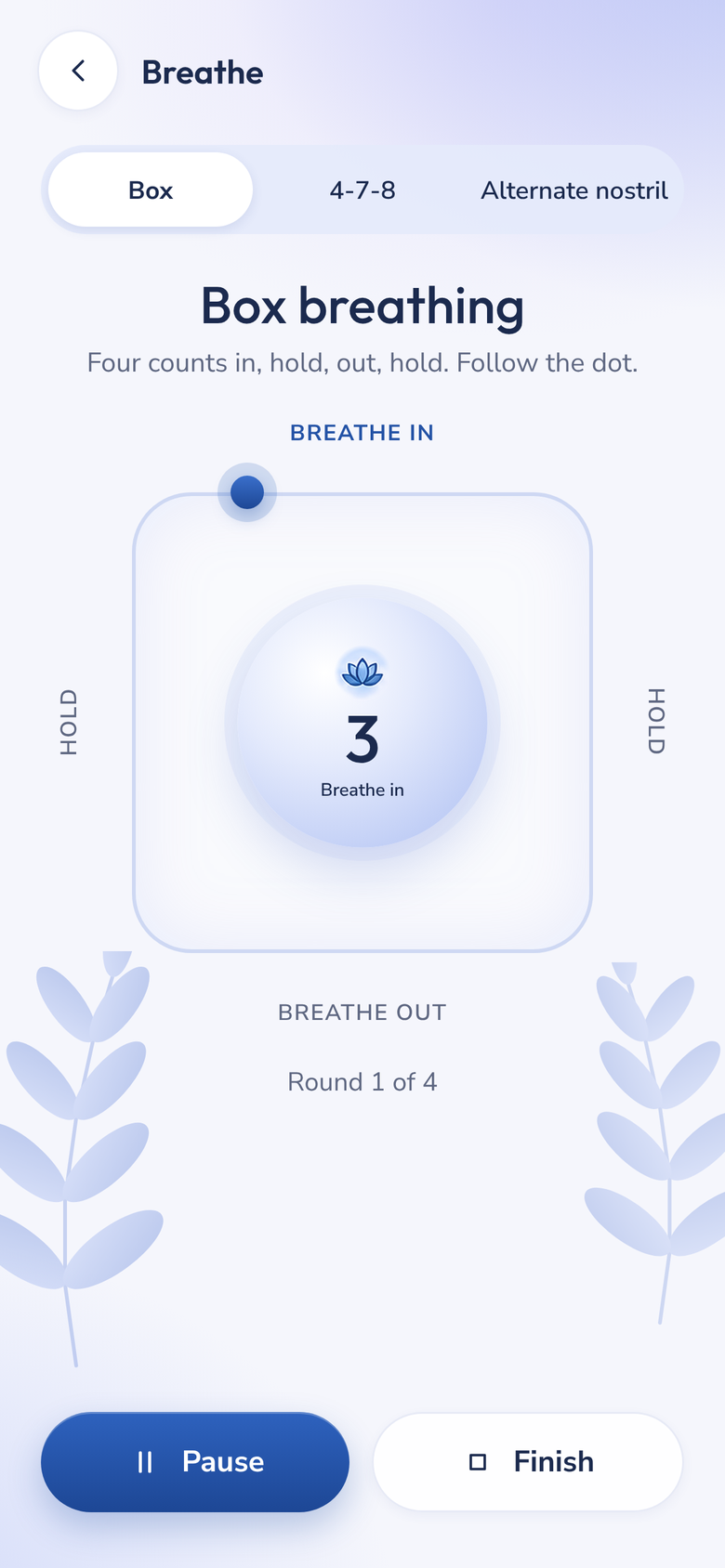
Breathe
Three techniques
Box, 4-7-8 and alternate nostril in one control.
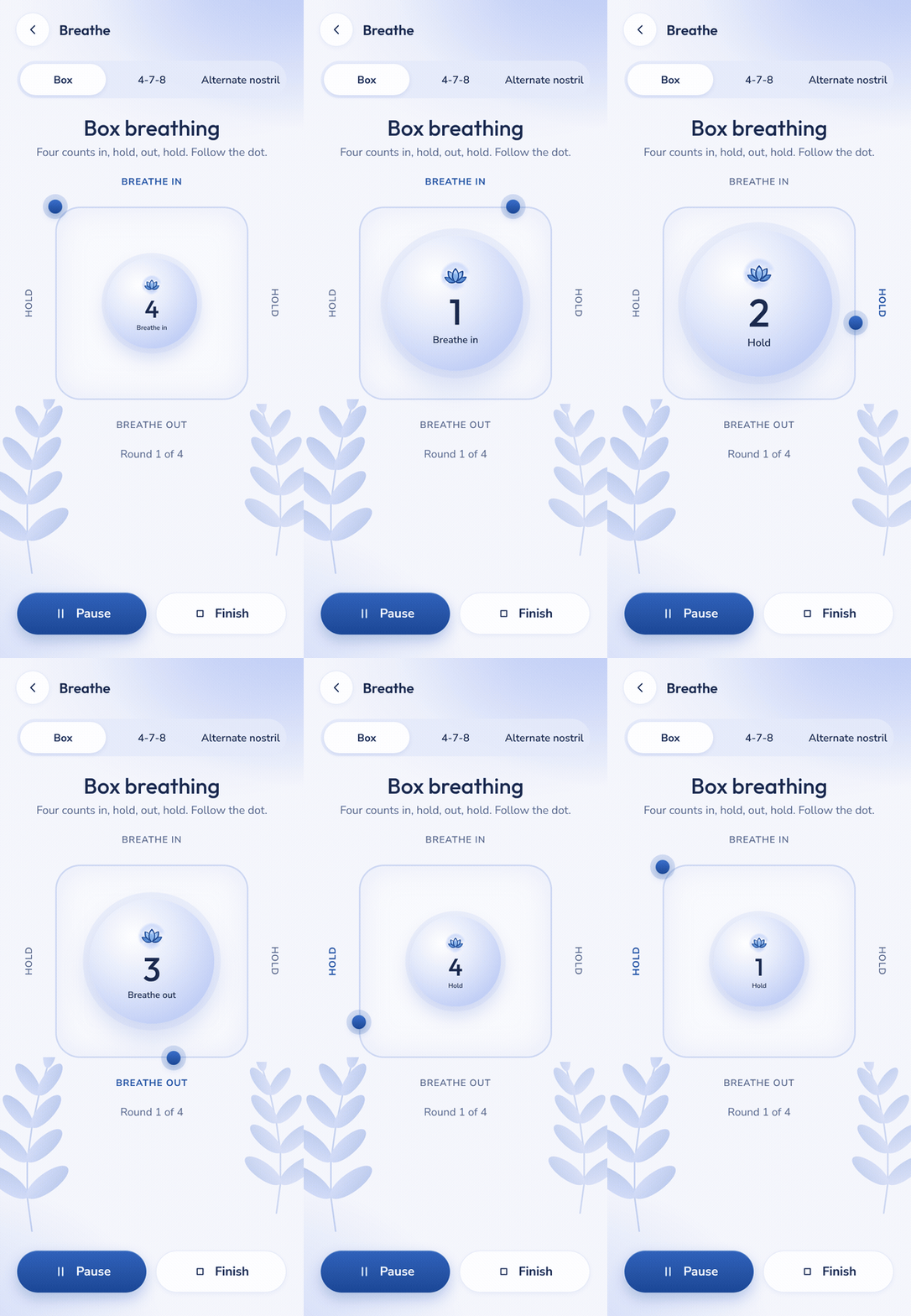
Follow the dot
It traces the box while the active phase label lights up.
Count and phase
The orb grows and shrinks with each breath; the count is announced to screen readers.
Pause or finish
Stop anytime. Finish leads to a gentle check-out.
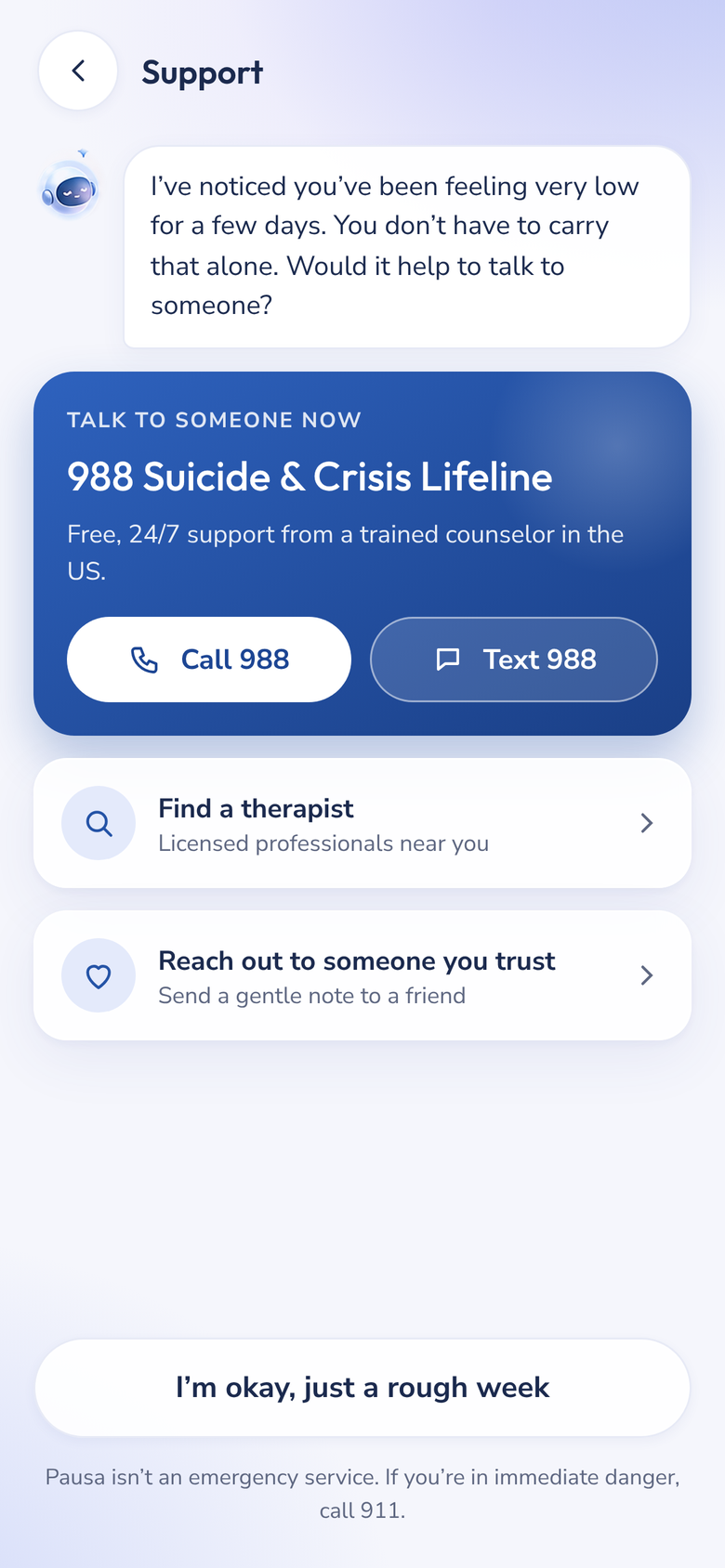
Support
Pattern noticed
Several very low check-ins open this screen.
988 in one tap
Call or text the Suicide & Crisis Lifeline directly.
More ways to a person
A therapist finder and a note to someone you trust.
A no-pressure exit
“I’m okay, just a rough week” closes it without judgment.
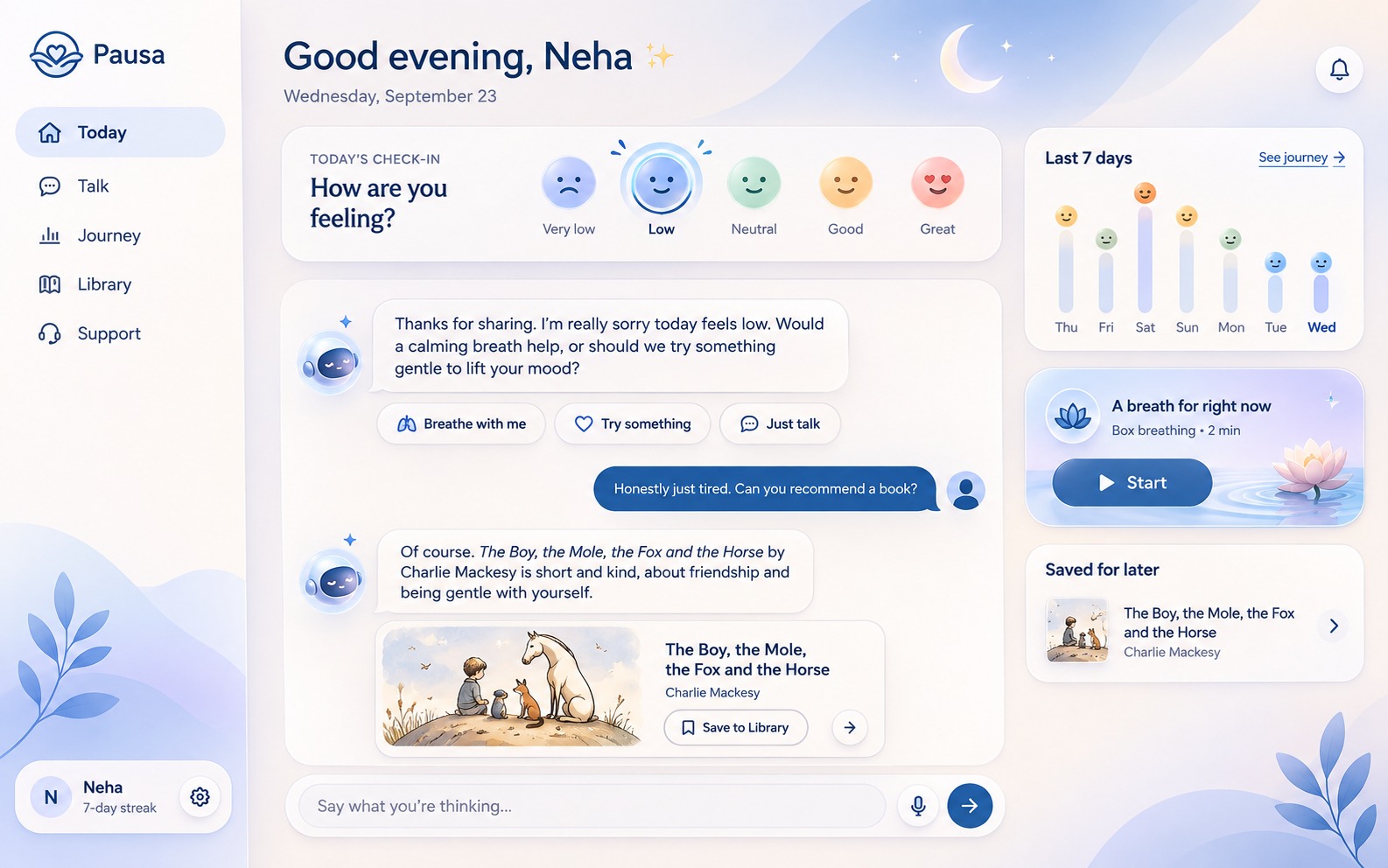
Hi-fi web
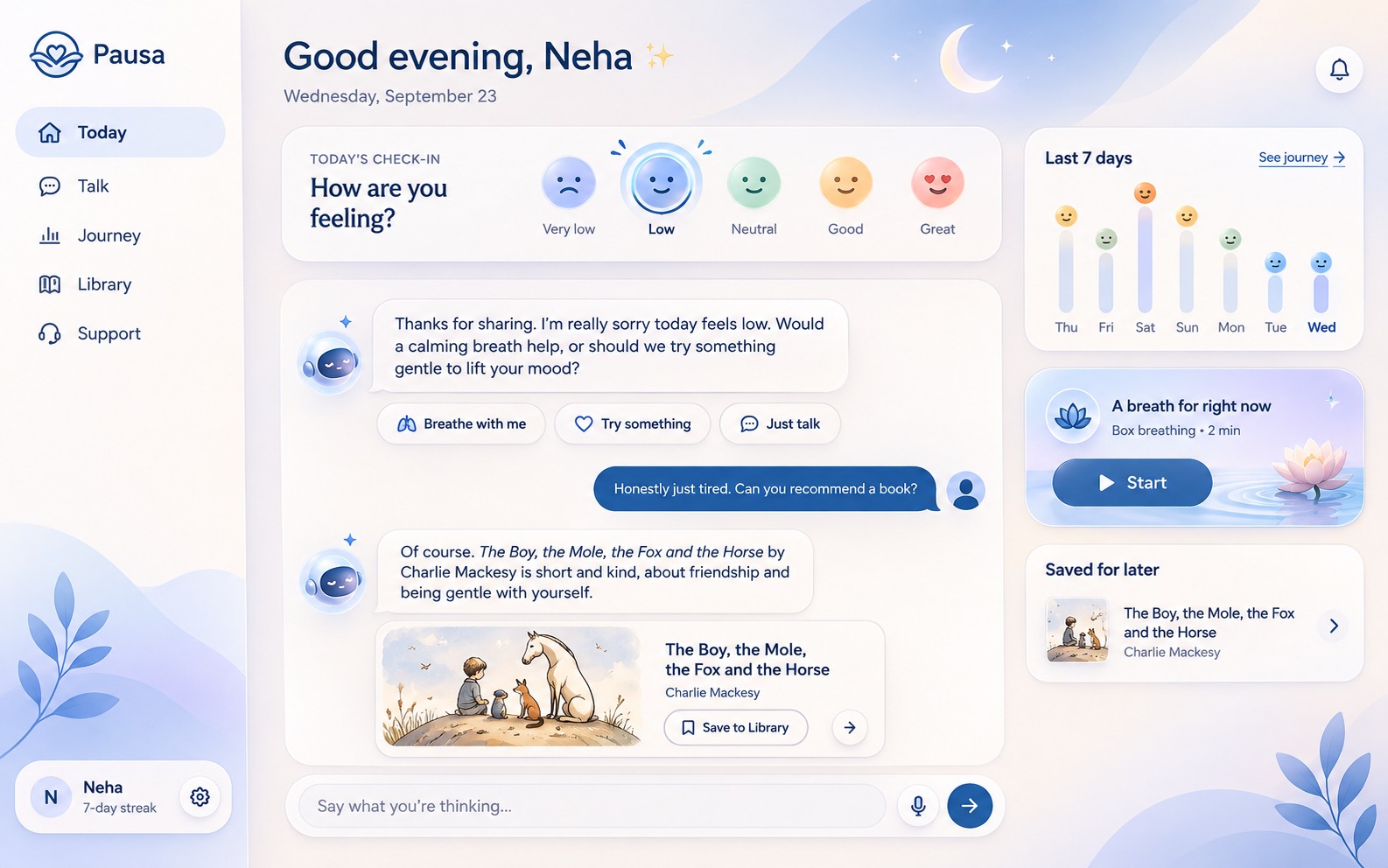
Check-in, conversation and patterns on one screen.
Where it goes next
Hi-fi
Mobile and web, end to end
< 1 min
Target time for a full check-in
Next
Moderated usability test, 5 to 6 participants
The difference between harm and help is not the technology itself. It is whether companies choose to build it responsibly.
Pausa is an independent design concept, not a medical device or a substitute for professional care. It began as Calmi; the agent persona, conversation flow and first wireframes were built under that name.
MORE PROJECTS
All work